You Are the Weakest Link. Goodbye.
A model writes about 20 times faster than you can read. Run three agents in parallel and the slowest part of the system is you. The numbers behind the gap, why reviewing is more tiring than writing, and what to change in the way you work.
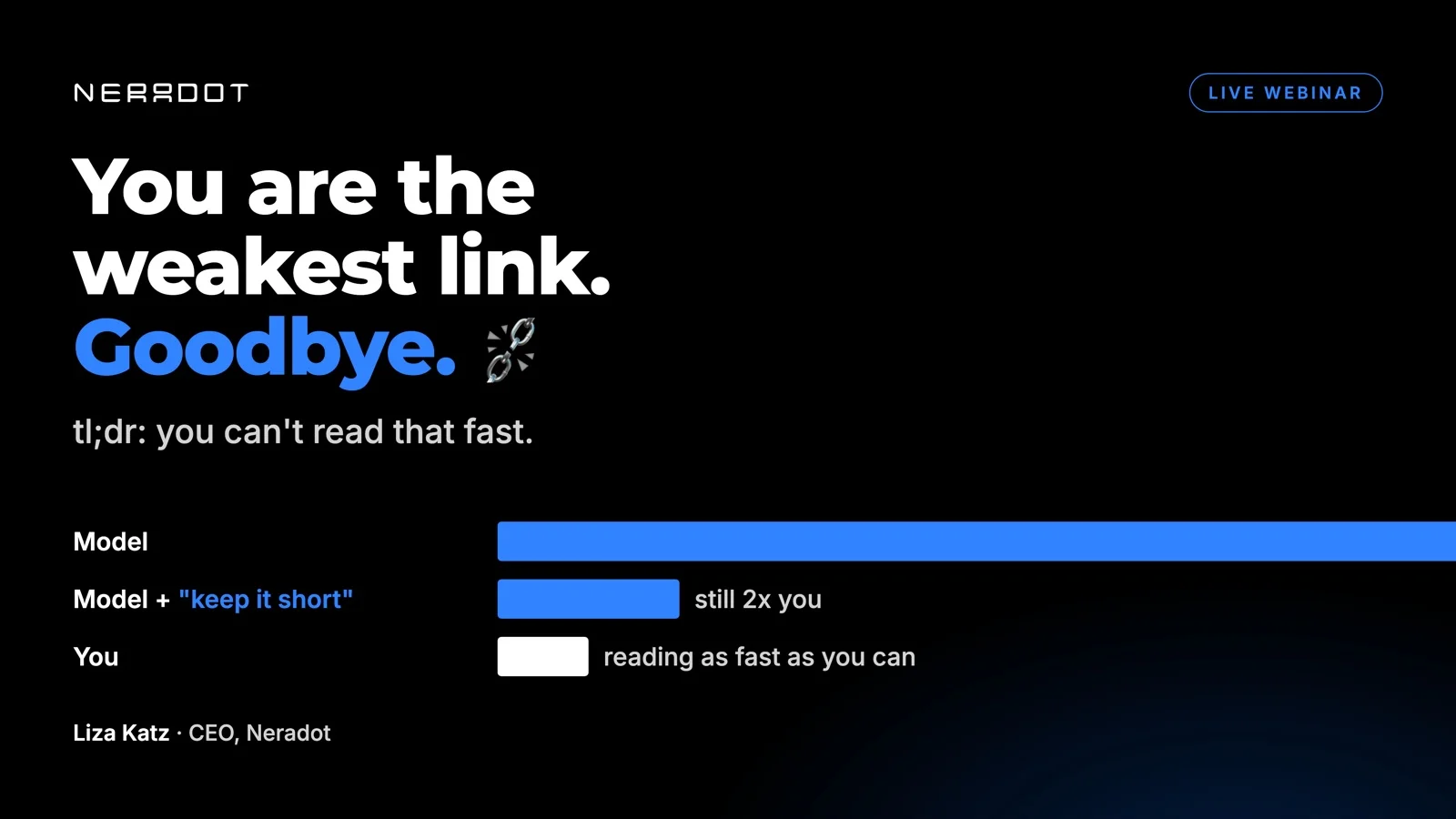
I write less code than I did two years ago. Much less. So why am I more tired at the end of the day?
For a while I blamed age, kids and the news. Then I did the math, and the answer was less personal and more annoying: I am the slowest component in my own system.
Humans have a fixed speed
Here is a number I love. In 2019 a group of researchers compared 17 languages, from Japanese to Vietnamese. Some are spoken fast, with little information in each syllable. Some are spoken slowly, with a lot. Multiply the two and every language lands in the same place: about 39 bits per second.
Reading works the same way. Veritasium has a lovely five-minute video about it, How Much Information?. An English reader takes in seven or eight letters at a glance. A Chinese reader takes in fewer than three characters, but each character carries much more meaning. The two cancel out, and both end up reading at the same pace.
So the limit is not the language. It is us. As the video puts it, what limits our communication is "our cognitive ability to process information". The brain on the other side can only take in so much, and languages adapted to it.
The other human speeds are just as modest:
| What we do | Speed |
|---|---|
| Type | about 50 words a minute |
| Speak | about 150 words a minute |
| Read | about 240 words a minute |
These numbers have not moved in a very long time. No firmware update is planned.
Models do not have this problem
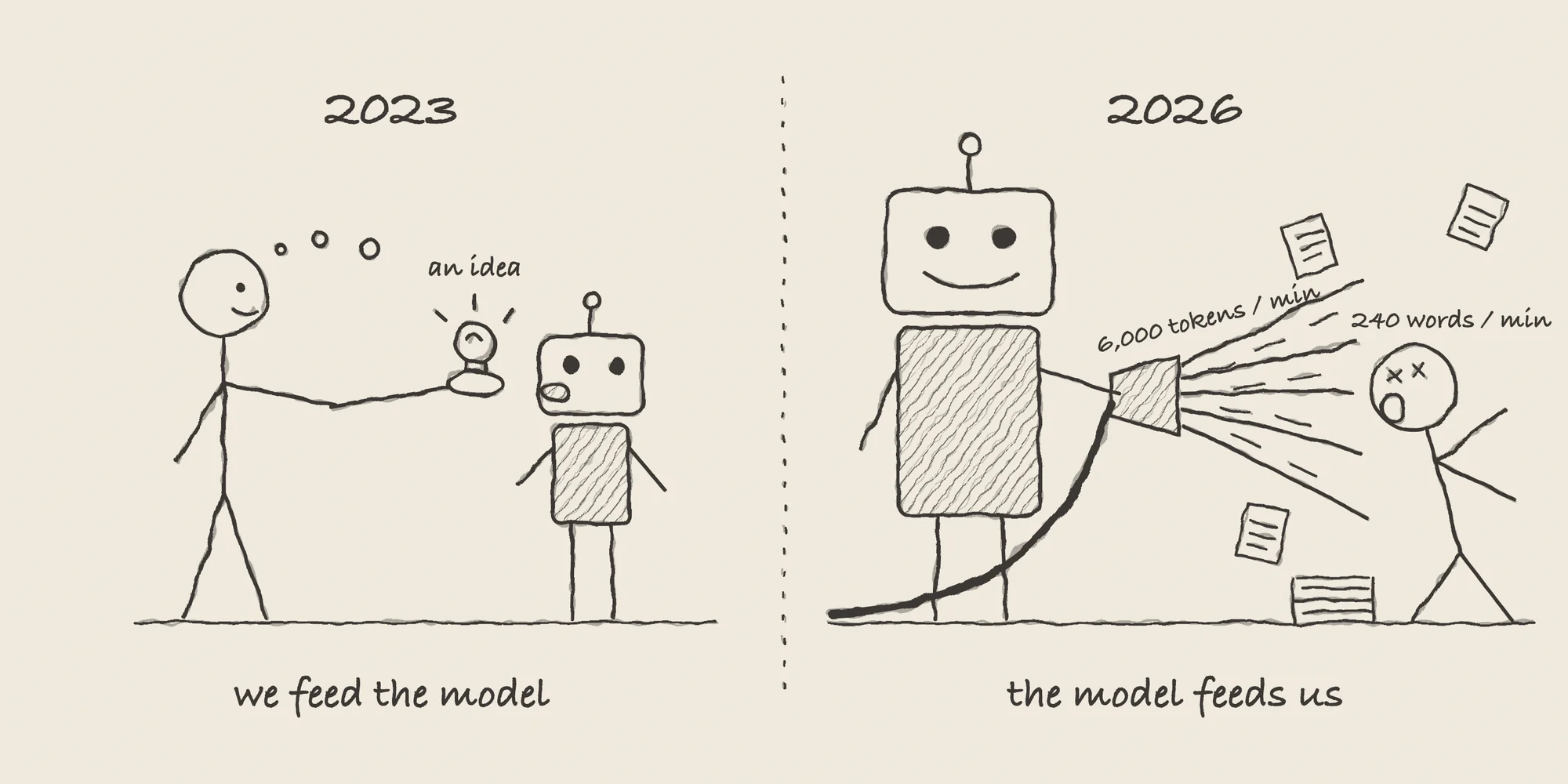
A frontier model today writes about 100 tokens a second. That is 6,000 tokens a minute, or roughly 4,500 words.
You read 240 words a minute, which is about 320 tokens.
So one model writes almost 20 times faster than you can read. And nobody runs one model anymore. I usually have three agents working in parallel, which puts me at more than 50 times behind before I've finished my coffee.
"But most of that is not for you", you say. True. A lot of the tokens go into reasoning and into code. "And you can tell it to keep it short." Also true, and I do. All my agents run in a mode that forces them to answer in as few words as possible.
So I checked what is left after both. I took my own coding-agent sessions from the last five weeks: about 236 hours of agent work and 27 million output tokens.
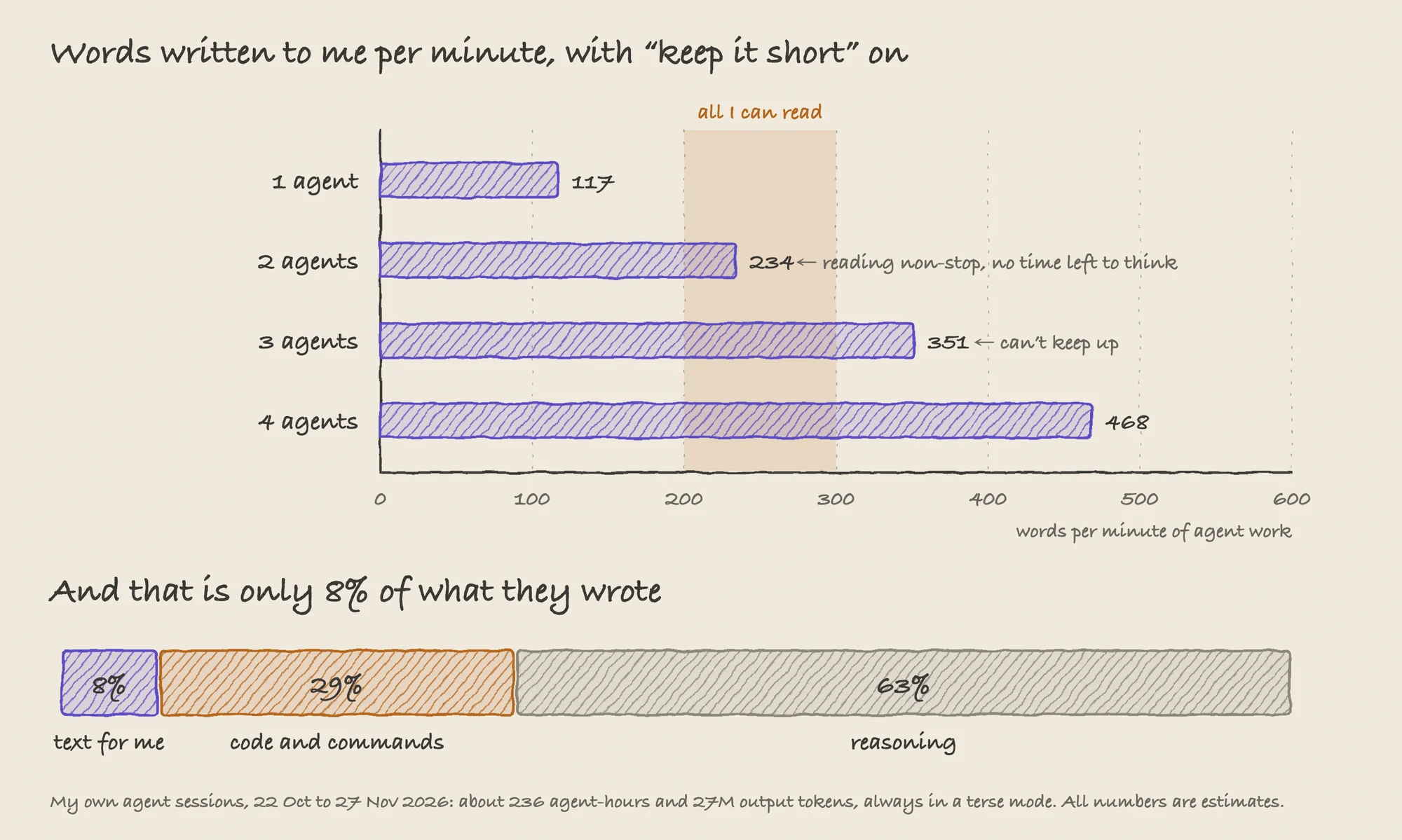
Only about 8% of what the agents wrote was text meant for me. The rest was code, commands and reasoning that I never saw.
That 8% is still 117 words for every minute an agent works. Half of my reading speed, from one agent, on its shortest setting. Two agents take all of it, which means reading non-stop with no time left to think. With three I am behind, and I stay behind.
In five weeks that came to about 1.65 million words. At 240 words a minute, that is 114 hours of pure reading. Of the "short" version.
And if I wanted to read everything, including the code and the reasoning? About 20 million words, or 1,400 hours. Five weeks of agent output is eight months of full-time reading.
This is what changed recently. The models were always faster than us. But the tasks were smaller and simpler: one question, one function, one screen of text. Even the slowest model wrote a lot, and if you kept it short you could somehow stay on top of it. Now an agent works for an hour instead of answering in a minute, and there are three of them. "Keep it short" still helps. It just no longer saves you.
Even the summary stopped helping. In those sessions a typical reply at the end of a task was about 220 words, and one in ten was over 470. That is a minute or two of reading each time, per agent, every few minutes. The summary of the work became the work.
Why reviewing is harder than writing
"Fine", you say, "but reading is easier than writing". I thought so too. It isn't.
When you write code, you build the mental model as you go. You know why every line is there, because you put it there. When you review, you have to rebuild that model from the outside, from text somebody else wrote, and then look for what is wrong with it. That is harder work, and we do it for more hours now.
This is not a new discovery. In 1948 Norman Mackworth sat radar operators in front of a clock and asked them to spot a rare jump of the hand. After about half an hour they started missing it. Watching for rare errors is one of the things humans are worst at.
Code review research found the same thing. A large study of code reviews at Cisco found that reviewers find far fewer defects after about an hour, or beyond about 400 lines at a time.
And in 1983 Lisanne Bainbridge wrote "Ironies of Automation", which describes our 2026 workday with scary accuracy. Automate the easy part of a job, and the human is left with the hard part: monitoring a machine that is usually right, and jumping in exactly when things go wrong. No practice, no context, full responsibility.
That is the job many of us have now. Eight hours of vigilance over text that is 95% fine. No wonder we are tired.
What I changed
I don't have a cure. I do have a few rules that made my days better.
1. Decide what you don't read. Reading everything is not possible, so "I read everything" really means "I skim everything and trust my luck". I pick in advance: the interface, the risky part of the diff, the tests. The rest I check by running it, not by reading it.
2. Ask the model for less. The model writes a lot because nobody told it not to. Tell it. "Answer in five lines." "Verdict first, details only if I ask." "Tell me only what surprised you." My output budget is 240 words a minute, and it is fair to say so.
I tested it on six ordinary developer questions: three extra words, "Keep it short.", cut the answers to about a third (from 393-1,008 words to 154-253). As the chart above shows, that is no longer enough on its own, so this rule is where you start, not where you finish.
3. Ask for evidence, not prose. A picture is worth a thousand words, and I can't afford a thousand words. So I ask for the thing I can check in five seconds:
- Anything with a UI: screenshots, and a recording of the full user journey.
- Anything backend: the real API input and the real output.
- Anything non-deterministic: the eval results, which cases flipped, and which errors are new.
"I fixed the bug and everything works" is 7 words I have to trust. A screenshot of it working is zero words, and I don't have to trust anybody.
4. Let a machine check the machine. Tests, evals, a second agent that reviews the first one. A machine can read at machine speed. I want to see the exceptions, not the whole stream.
5. Move to the ends of the chain. The middle of the work, where text is turned into more text, is where I am the weakest link. The ends are where I am still worth the wait: at the start, deciding what we build and what "good" means, and at the end, deciding whether to accept it. I try to spend my attention there and stop acting as a relay between agents.
6. Run fewer agents than you can. A fourth agent feels like more output. In practice it is a longer queue in front of the same slow reviewer. An agent that waits costs nothing. A tired human who approves things without reading them costs a lot.
Goodbye?
In the TV show, the weakest link is voted out and walks off the stage. I don't think that is our ending. A chain needs someone to decide what it is pulling.
But the old way of working, where a human reads every word the machine writes, is already gone. It didn't end because we became less important. It ended because of arithmetic.
Want the live version? I'm giving this as a talk, with more numbers and fewer jokes (or the other way around). Wednesday, December 16, 20:00 Israel time, online, in Hebrew, 30 minutes plus questions. Register here. A recording goes to everyone who signs up.