Webmaster, Full Stack, ML Engineer. And Now FDE?
Every few years engineering gets a shiny new job title, and every one of them rewarded going deeper into the tech. The forward deployed engineer is the first to reward something else: people, product and selling. A personal take on why that combination is so rare, and why everyone is hiring for it.
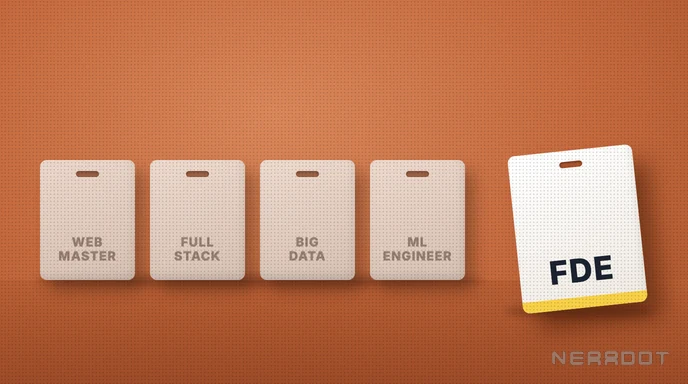
There has been a shiny, sexy new job title in our industry pretty much since coding started. Recruiters put it in every post, LinkedIn headlines change overnight, and suddenly everyone you know has been doing it "for years, actually".
Right now that title is Forward Deployed Engineer, or FDE. Every AI lab has an FDE team. Every AI startup wants one.
So naturally my first reaction was: oh no, here we go again.
We've seen this movie before
My own journey started in the mid 2000s, so the first job title I ever met was a webmaster. He was the guy responsible for that website. You know, the one that wasn't part of the core product the real devs were working on. (Google held on to the word until 2020, and dropped it after finding that almost nobody calls themselves a webmaster anymore.)
Then the website became the product, and the guy with the website was not enough. We needed someone who could handle the browser, the server and the database, and we started calling that person a full stack developer.
Then shipping once a quarter stopped being acceptable. Someone had to own the servers and the pipelines too, and a small 2009 conference in Ghent called DevOpsDays turned into a job title. You don't "do DevOps" anymore, you are a DevOps engineer.
Then the data got big. In 2012 Harvard Business Review called data scientist the sexiest job of the 21st century. Everyone learned Hadoop. Few of us needed it.
Then the models got good, and by 2017 ML engineer was number one on LinkedIn's emerging jobs list.
It's the same story every time. Something changes in the tech, and the industry goes looking for the engineer who can handle one more layer of it. Front end plus back end. Plus servers. Plus data. Plus models. Every wave rewarded the people who went deeper and deeper into the machine.
This time it's not the tech that changed
Around 2022-23, as AI products started becoming popular, something else broke: the business model.
The SaaS playbook was simple. Build a good product, make onboarding smooth, and let customers adopt it themselves. With AI that doesn't work. Every company's data is a different kind of mess, every workflow is weird in its own way, and the gap between "the demo worked" and "it works on our data" is huge. You can't sit and wait for your customers to cross that gap on their own. Most of them won't.
So everyone leaned in hard into solution architecture, and started sending engineers to sit at customer sites. Palantir had been doing exactly that since the early 2010s, and for years had more of these engineers than regular ones. Now the AI labs do it too, and the engineer they send has a name: the FDE.
What the job actually is
On paper it sounds like one more layer. You need to understand the customer's stack, their tools, and AI. Fine. That part is familiar.
But follow an FDE through a project and you see the rest of it.
You arrive, and the first job is discovery: figuring out what the problem actually is, which is almost never what the ticket says. Then you need people to tell you the truth about their data and their process, so you build relationships. You manage expectations, you hear the politics, you deal with the engineer on their side who feels threatened by you.
Then you build the thing, and stay until it works in production.
And while you build, you're doing product work: you notice that what this customer needs, three other customers will need too. That's the roadmap, and you're the one standing close enough to see it. And if you did all of it well, the customer wants more, which means you were also selling the whole time. Nobody likes to say that part out loud.
We've seen this play out ourselves. One of our projects started as a small analytics agent: one team, one narrow set of questions about their data. Nobody asked us for a product. But we were sitting close enough to see who else kept showing up with questions, and what they were really trying to find out. That small agent turned into a full product, and from there it spread into more departments. The agent itself was the easy part. Knowing where it should go next was the job.
A new kind of person on stage
And that's what is really different this time.
Every previous wave rewarded deeper technical understanding. This one pushes a new type of person to the front of the stage: someone who has the technical depth and great interpersonal skills, product vision and the ability to sell.
That combination is rare. Most great engineers I know are great because they love going deep. Most great product and sales people I know would never want to debug a retrieval pipeline at 11pm before a demo. People who are genuinely good at both always were hard to find, we just never built a job title around them before.
That's why postings for FDE jobs went up more than 800% in nine months of 2025, while layoffs seem nowhere near the end. The industry doesn't need more people who can go one layer deeper. It needs people who can stand with one foot in the code and one foot in the customer's business, and there just aren't many of them.
Will the title last? I don't know. Webmaster didn't. But I think this kind of person is here to stay.
If this sounds like you
If you're a forward deployed engineer, or you're looking to hire one, we started a community for exactly that: FDE Israel. Open roles, people looking, stories from the field, and meetups.